Welcome

Welcome and have a look at my work for Distant Stitch - Creative Sketchbooks, Module 6, with tutor Lizzy Lewis

In this module I will make a free-standing book on a theme chosen by me - Close to my heart.

Dienstag, 12. Juli 2016

Chaper 2: Hands and eyes


The drawings were done in my sketchbook (A5) on various sorts of lightweight sketching paper.

5.2.1 Drawing in an outline of the hand

Hand_1 B3 pencil


5.2.2 Hand drawings
 
Hand_2
3B pencil. 
I looked at my hand through a sheet of transparent plastic with aid lines to get the initial points in the right place. The horizontal and vertical lines are still visible.
   
Hand_3
Details drawn with pencil on an old letter coated with gesso.
   
Hand_4
A sketch after a da Vinci painting and my own hand (difficult position for the hand).

Also with 3B pencil
   
Hand_5 Drawing on gessoed letter with a B pencil
   

Design with hand shape

I made a template from the first sketch.

 
Hand design 01
17x22,5 cm

Overlapping outlines, painted with watercolours on a leftover piece of map goated with gesso. The lines of the map are still shining through.
   
Hand drawing bw A4
Hand shapes, one of them filled in with ornaments, done with permanent ink and calligraphy pen on 160g cartridge paper.

The ornaments seem to indicate the wrinkles and lines on my hand.
   
Hand design 03 The above drawing painted with watercolours.
   
Two hands bw Nine hands
Scan of the ornament hand shape,
moved around on the computer with Paint.
Nine hands 01 Nine hands 02
Nine hands 03 Variations done with Picasa
   
Hand design 02 A cutout print of the ornamented hand and a cutout from a monoprint with a Gelli plate, glued on decorated papers from a former module.


Eyes

5.2.3 Collection of portraits with eyes as a powerful feature

I found a lot of portraits in my art books and made scans, here are some of them. The range of expressions conveyed by the eyes is amazing!

da Vinci_Portrait_Ginevra_Benchi Leonardo da Vinci: Portrait of Ginevra Benchi
   
Lucian_Freud_3 Girl in a dark jacket
by Lucian Freud, 1947
   
Egon_Schiele_5
Self-portrait in uniform (detail)
by Egon Schiele, 1916

   
Michelangelo_Sistine_Chapel_1 Detail in the Sistine Chapel, Michelangelo

All the figures in this painting seem to be awed, afraid or overwhelmed.
   
Giovanni_Giacometti_Annetta_1 Annetta
Giovanni Giacometti, 1908/10
   
IMAG0041 Portrait Dora Maar, sitting in a chair (detail)
Picasso, 1938

I like the way the right eye is looking back at the left.


5.2.4 Drawing my own eyes

My friend Ilona took a couple of portrait photographs (thanks, Ilona!), which I used for drawing. It is a bit stressful for my eyes to draw looking into a mirror. The drawings are mostly done in my sketchbook (A5). 

Eyes_1_Pencil The first sketch with a B pencil, always good for exploring.

After the shock of seeing exactly all these wrinkles I was intrigued by the half-moon shadows at the top of the irises.
   
Eyes_2_ballpoint pen Ballpoint pen

I was so focussed on the medium – no corrections possible - that I neglected the correct position of the eyes. Looks like a lemur.

   
Eyes_3_Conte carre
Staring in the mirror with my glasses on. Conte Carré stick invites a more spontaneous line.  Also I cannot see so many details this way.
   
Eyes_4_Pencil 8B pencil, drawn from another photograph. Would you believe I am grinning? The nose is not right.
   
Eyes_5_Sketching pen Eyes_6_Sketching pen wash
The same photograph drawn with a sketching pen and water soluble ink on 190g very smooth cartridge paper, A5. Water brushed on and dabbed away for lighter and deeper shades. I like the result, it is less exact and more vivid.

Sonntag, 10. Juli 2016

Chapter 1: Making a folder or pocket book


What a great way to use collections of maps and memorabilia!

It is great fun, and I am looking forward to making more folders and variations as I get on with the Module. (I hope I have understood the brief correctly.)

Zigzag folders
The first zigzag folder
Leporello_Folder_01 20x25 cm

My first folder is for sketches and paintings inspired by my walks.
Leporello_Folder_03 Leporello_Folder_05
For the folder pages I used an old Ordnance Survey map. The creases are machine-stitched to add stability and emphasize the creases. I cut the map in two pieces and connected the folded pages with machine stitching.

The second zigzag folder

Leporello_Folder_12 32x32 cm

For this really big folder I used two pieces of strong cardboard.

Leporello_Folder_09
I have not yet put anything in the folder. The pages are free for decoration – or for glueing on smaller pockets?
Leporello_Folder_11
The two parts of the folder are glued on a piece of bookbinder’s lining.
 Origami folder
I love this way of using old papers! But you need really big sheets to make pockets of any size.
First origami folder
Origami_Folder_01 20x27 cm

This folder is for material connected to maps (an ongoing  obsession).  
Origami_Folder_02
Some pages were folded with sheets from an outdoor magazine, glued together for bigger size.
Origami_Folder_03
I made smaller pockets from Kraft paper and magazine pages for feathers and other small items.
Origami_Folder_05
Second origami folder

Origami_Folder_07 Size A4
I made this folder as a birthday present for my friend who loves to collect brochures, tickets and more on strolls, exhibitions and travels.

The cover is decorated with a stitched piece of silk stretched over an old book cover. The upper and lower edges are glued with pieces of blue cotton which also forms the spine. 
Origami_Folder_09 The pages are made from a weekly my friend likes to read. (And it has big sheets.) I tried to fold the pages so that the illustrations show up.
Origami_Folder_11 Origami_Folder_13
Origami_Folder_16 I stitched the pages by hand to the cotton spine with thick silk thread.

My friend was very pleased!

Envelope folder

 My first envelope folder contains drawings and material from the  last module. It is made from used A4 envelopes which my colleagues have collected for me.


Back side


 I glued the envelopes with PVA glue. The double sided sticking tape is not strong enough to keep the envelopes together when used.


Envelope_Folder_01
My second envelope folder contains more A4 envelopes. It is for work in this module, and I have not made a cover yet.

Montag, 28. März 2016

Chapter 10: Postscript


Here is the text of the Christian Morgenstern’s poem as a whole, and, for better understanding, my English translation (which cannot do justice to this lovely humorous piece).

Die weggeworfene Flinte

Palmström findet eines Abends,
als er zwischen hohem Korn
singend schweift,
eine Flinte.

Trauernd bricht er seinen Hymnus
ab und setzt sich in den Mohn,
seinen Fund
zu betrachten.

Innig stellt er den Verzagten,
der ins Korn sie warf, sich vor
und beklagt ihn
von Herzen.

Mohn und Ähren und Zyanen
windet seine Hand derweil
still um Lauf,
Hahn und Kolben …

Und er lehnt den so bekränzten
Stutzen an den Kreuzwegstein,
hoffend zart,
daß der Zage,

noch einmal des Weges kommend,
ihn erblicken möge – und -
(… Seht den Mond
groß im Osten …)


The gun that was thrown away

As Palmström is walking one evening,
singing among high corn,
he finds
a gun.

Grieving, he stops his song
and sits down among the poppies
to look at
what he has found.

He imagines the disheartened person
who threw the gun into the corn field
and deplores him
with all his heart.

Meanwhile, his hand winds
poppies and wheat ears and corn flowers
around the barrel,
the handle and the cock,

and he leans the gun he has thus garlanded
against the stone at the crossroads
tenderly hoping
that the disheartened one

coming this way again
might see it – and -
- look at the moon,
large in the east!

Sonntag, 27. März 2016

Chapter 10: Altering my book, Part One


The server seems to have a difficulty uploading this post, so I split it into two parts.


1. Preparation

1.1 Choice of book

The first book I had bought was a picture book with high gloss pages. The size and number of pages fitted the project well, but the paper warped so much when I glued it that no amount of pressing helped. I then found an old library book on my shelves. Its paper is rough and behaves much better after being glued.

Size 18x21 cm

79 pages originally

Book

Having been a library book, it had a plastic cover which I had to remove,. I also cut the block out of the cover to make stitching and handling easier. After the plastic had been removed the spine fell off, it was so worn. I used sturdy paper as overleaf to reconnect block and cover and glued in a new spine.


Block and cover

2.  Block and cover

To prepare the ground I glued papers together in pairs, then cut or tore many of them and wove in strips of other papers. Some woven pages were machine-stitched, most were painted with gesso. All this taken together made for  interesting textures to work on, but the pages became more like cardboard, especially when I glued further things in. I think another time I will be more careful.

Gesso on the page

3. Woven, stitched and gessoed page (right). The left page is the first and will be glued to the overleaf.

Pages woven and stitched

4. Another woven and stitched page. I like the way the images get broken up and mixed, it suggests further designing.

5. Planning the pages

I had some quite definite ideas for some pages and thought a lot about others. Below are a few pages from my sketchbook with thumbnail sketches for the book.

Sketchbook 08 Sketchbook 01
Sketchbook 02 Sketchbook 05


2. The book


The  book

My story is a poem called “Die weggeworfene Flinte” – “The gun that was thrown away” by Christian Morgenstern (1871-1914). It is one of my favourite poems. It works around an idiom: “Die Flinte ins Korn werfen” – “to throw the gun into the corn field” means to lose hope, to give up. The main character in the poem is Palmström, a most likable and quirky person, the hero of many of Morgenstern’s poems. I am sorry I did not find a good English translation which could have conveyed the charm of the poem.

20 pages / 10 sheets of paper, plus 2 extensions

Size 18 x 21 x 3 cm

IMG_1563 IMG_1562
Back view Spine


Cover
 
Front cover Back cover
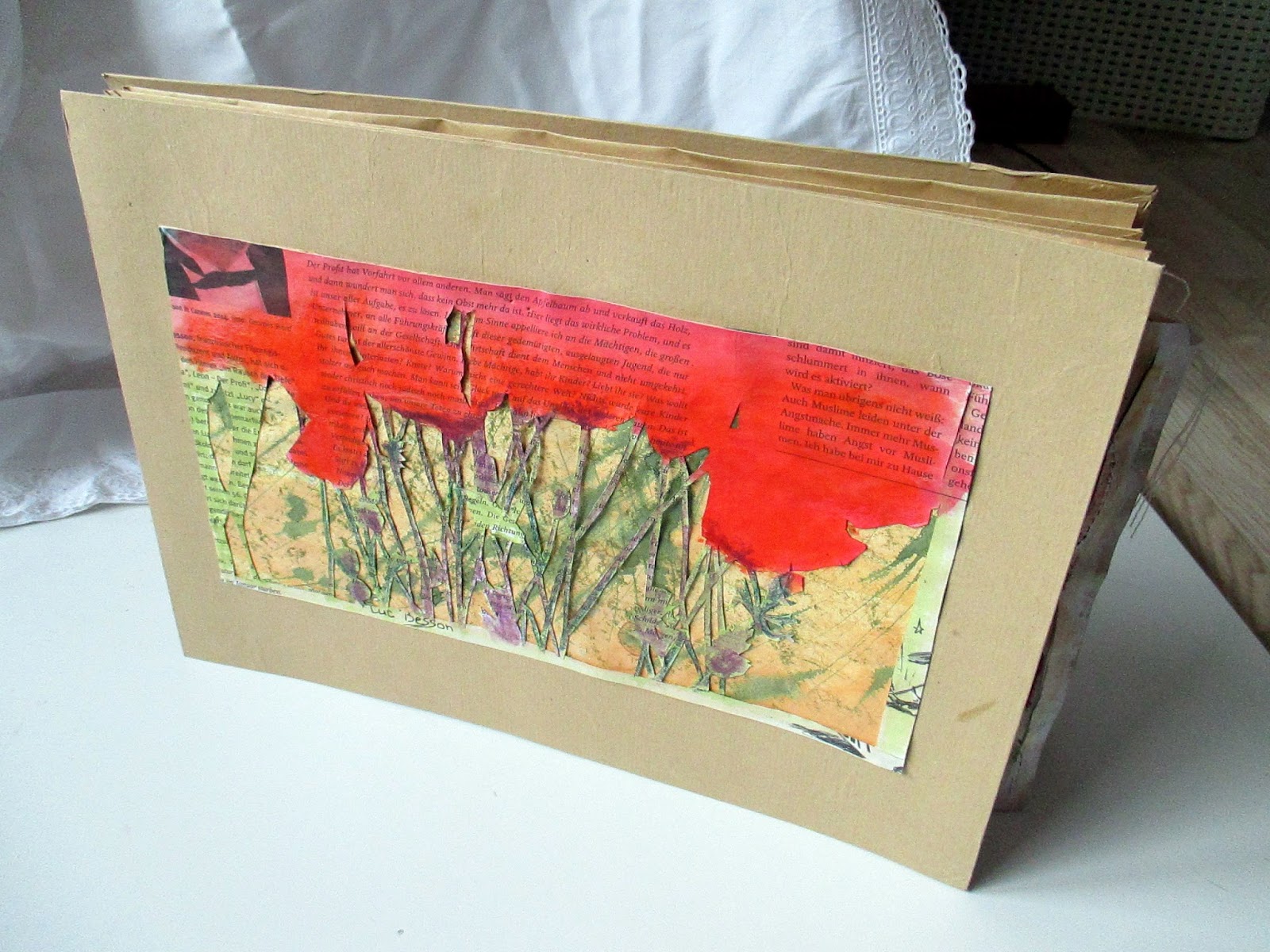
I glued one of my woven and stitched background papers, printed with poppies, on the original book cover. To match the colours I added a light wash of ochre gouache. The shoes, one of my line drawings, were coloured with Neocolor II and inktense pencils and glued on with PVA glue. The brown stripe was coloured in to give the shoes something to stand on.

To attach the shoelaces (leftovers from a much loved and worn-out pair of boots) I made holes in the covers, pulled the inner strands of the laces to the inner side and glued them firmly along the edge of the cover. This was later covered and secured with the overleafs (overleaves?).

IMG_1558


Overleaf front

A geometric version of a poppy image (see below) was the starting point for the drawing on the overleafs. They were drawn freely with acrylic ink (the black lines) and the nozzle of the ink bottle on Kraft paper. I then printed the petals with gouache and added the “music clouds”, which will turn up throughout the whole book.
Overleaf front
Poppy_template Poppy_template-003


Title page  
“The gun that was thrown away”

I traced the lines of the poppies, stems and leaves from a drawing and coloured them and the background with Neocolor II and Inktense pencils. The text was printed on transparent paper and glued in with matt gel.
Title pages


Page 1-2  
“As Palmström is walking one evening, singing among high corn, he finds”
Page 01 Page 02
A rubbing of the sole of my walking boot is the first layer here, done with an A6 pencil on tissue paper, then glued on a woven, stitched and gessoed ground. I coloured the sky with Neocolor II and printed the wheat ears with gouache.The musical clouds are cut out from copies of notes.


Page 3-4 “a gun”
Page 03 Page 04
   
Pages 03_04 opened The shoes open up to show the whole gun.
The background and the shoes were done in sgraffito technique with gouache, transparent oil pastel and Neocolor II. I stitched the shoes to the side of the page. I wanted the gun to be brighter than the rest, so it is just coloured with Inktense pencils and silver ink.


Page 5-6  
“Grieving, he stops his song and sits down in the poppies to look at what he has found.”
Page 05 Page 06
Again my geometric poppy experiment provided the idea for this page.
Neocolor II on woven and stitched pages without gesso. For the poppy petals I used tissue paper with rubbings from a shell and a gouache wash.  
Pages 05_06 opened Page 6 opens up to show gun details. Red paper from a flying lantern was glued on the woven page.
 
The patterned piece is a collage from one of the gun details, printed on copy paper and glued on the red background.


The handle is painted with Neocolor II, inktense pencils and silver ink, and then hand-stitched with zigzag stitch. The other ornaments are drawn with gel pen and felt tip pen.